
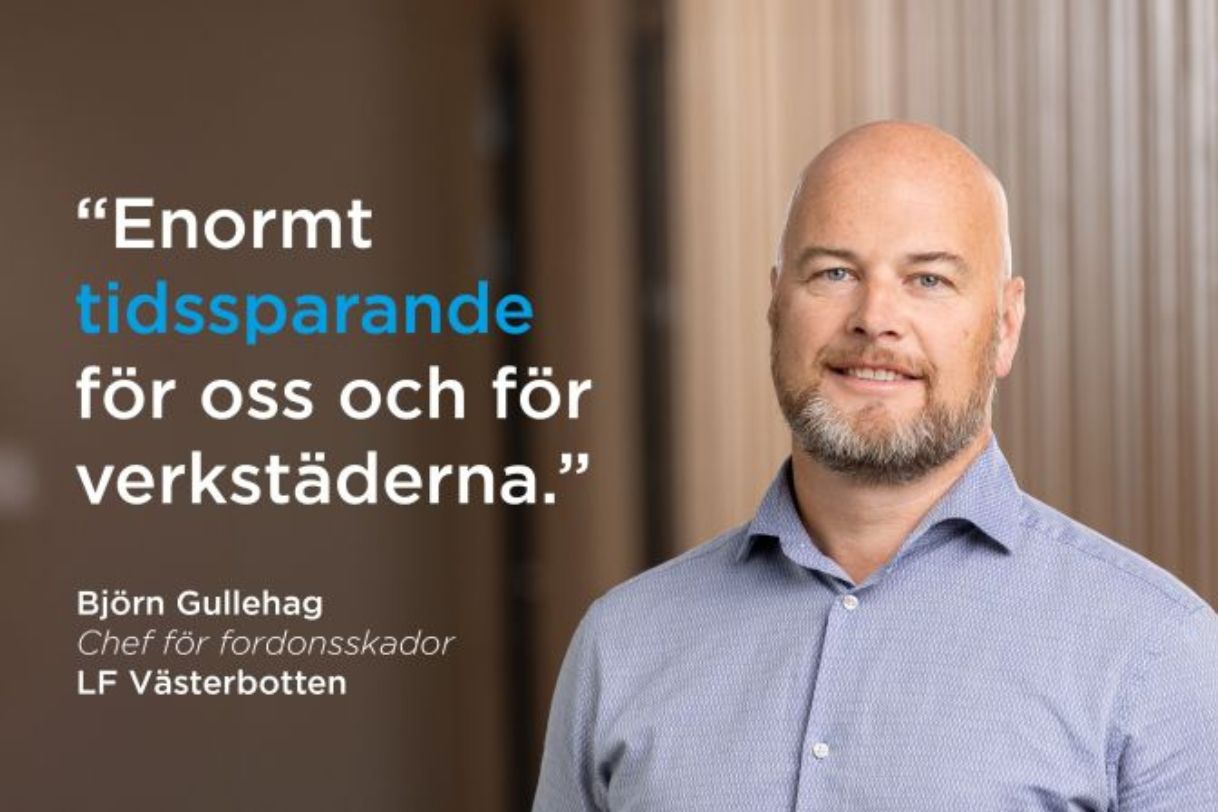
LF Västerbotten have used Autonet since April 2025 and have, since then, lowered both their average claim cost and their CO2 emissions.
We spoke to Björn Gullehag, Head of Vehicle Claims at LF Västerbotten, about their experience using Autonet over the past year: how it has made the claims department’s job easier, the value of Autonet’s workshop allocation, and the impact on customers and workshops.
Could you start by telling us a bit about what has using Autonet been like — from when you started until today?
We started using Autonet in April 2025, and it’s been an eventful journey throughout the year. When we launched, we worked hard on getting the workshop allocation right so that cases ended up where we wanted them. We tweaked and fine-tuned the flow until it was as efficient as possible, which has now lowered our average claim cost.
Early on we also had a lot of contact with the workshops to make sure they picked up Autonet cases and managed them correctly. Overall the feedback from the workshops has been positive, even if the response was a bit mixed at first: not all workshops are keen for changes instated by insurance companies. But most of them have realised the benefit of avoiding physical inspections, and that they can now spend more time on their business instead of bringing customers in unnecessarily.
It’s also been exciting to see the new features developed by Autonet and to, on our end, try to get as much value from them as possible.
In your opinion, what are the biggest benefits of working with Autonet?
The workshop allocation is what delivers the biggest impact numbers-wise — it’s what has lowered our average claim cost and generates the financial gain.
I think the service provided to the customer is another important aspect — that they don’t have to make an extra trip to the workshop. Many customers are far away from a workshop and now they don’t have to drive there on an extra occasion for the inspection.
Our claims department also saves time, especially since we changed the workflow so that customers create their case in Autonet themselves after filing their claim with us. In these cases, the customer actively chooses to continue on a digital path, which I think is very positive. It also means that case continues to progress even when we’re not at work. The workshop will already have received some work by Monday morning when they come in, because the customers could automatically progress their cases over the weekend. That’s definitely a big advantage, because many customers use the digital process themselves.
The pace of development is another benefit: Autonet has developed and adapted to our needs and in collaboration with us, and it’s both fun and rewarding to be able to shape the system we’re working with. It’s honestly liberating to work with a system where changes can happen from one week to the next.
You mentioned the system saves time for the claims department: how has the day-to-day work changed for your claims managers and insurance engineers with Autonet?
It’s a big advantage that the system saves time for both our case managers and insurance engineers.
For our case managers, it comes down to a few things. For one, it’s faster to enter a case into Autonet than the system we used previously. Secondly, case managers need to manually manage cases much less frequently now thanks to the automatic flow.
There has also been a shift in the case manager’s role in the process. They no longer have a steering function because the system automatically sends the case to the right workshop. The case manager can therefore focus fully on the customer interaction and making it as satisfactory as possible. Previously, it was easy to end up arguing with the customer about which workshop they want to go to, and their wishes often don’t align with what’s best for the customer or for us. Now we’ve set our parameters in the system and customers typically have no objections to the workshop selected for them. This means that we save more money, since the workshop allocation is what most directly affects our claim cost.
Our insurance engineers also save time when we use Autonet. The more cases we get to workshops we trust, the more cost estimates can be automatically reviewed and approved. Then the insurance engineers can spend more time on other tasks, like going out and working more with the workshops to educate them on the value of using the system to its fullest: with used parts, repairing parts, receiving more cases. In short, they can spend more time building and maintaining relationships
As a final question, what would you say to someone who’s thinking about using Autonet?
The more efficient workshop allocation is enormously important — it saves money and makes using the system economically viable.
Beyond that, Autonet helps everyone involved in claims management. The customer has a smoother process, the workshop gets a better tool to work with which gives them more time to repair cars, and case managers and insurance engineers save time, which lets them focus more on relationships with customers and workshops.
On top of that, you get to work with a responsive, fast-developing product!
Would you like to try Autonet and make your claims department’s work smoother?
Contact Torsten Östervall at torsten.ostervall@autonet.se or +46734472233. You can also read more about our products and how we help different organisations in the vehicle claims industry!